
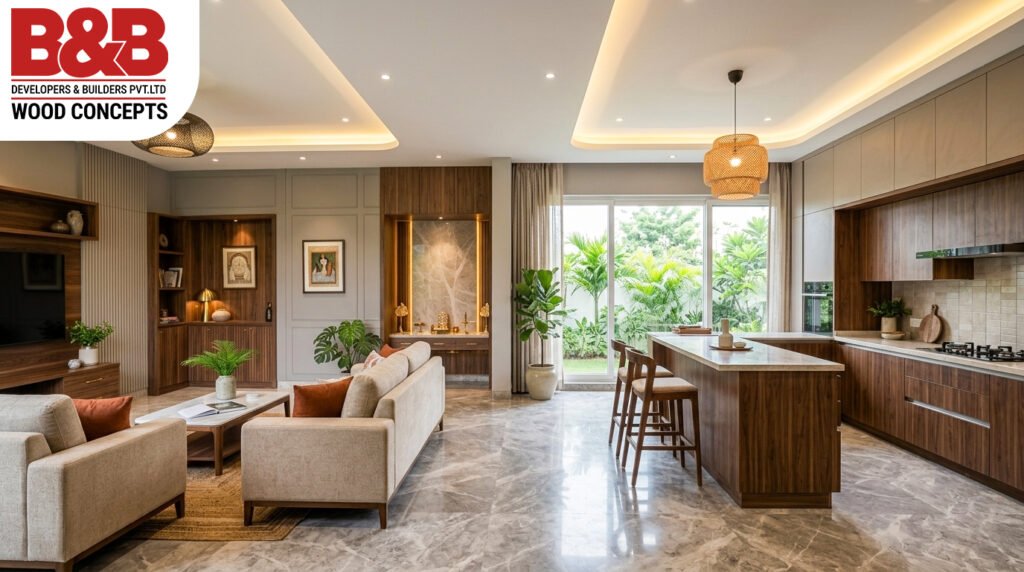
Homeowners in Vellore are increasingly choosing custom wood-based furniture, functional modular kitchens, layered lighting, natural materials, and multi-purpose spaces over generic, catalogue-style interiors. The shift is less about chasing trends for their own sake and more about wanting homes that are personalized, durable, and genuinely functional for how families actually live. Below are 10 trends showing up consistently in recent residential interior design projects, along with why each one is gaining traction.
Interior design trends move fast on social media, but not every trend translates into something worth doing in a real home. This list focuses on the ones that are both popular and practical — the kind of choices homeowners are making because they solve a real problem, not just because they photograph well.
Ready-made, modular furniture is convenient, but more homeowners are opting for custom-built wood furniture designed around their exact space and storage needs. A custom wardrobe or kitchen unit can be built to fit an unusual room dimension precisely, something generic furniture often can’t do well.
Why it’s trending: Homeowners are prioritizing long-term fit and durability over the speed of off-the-shelf furniture.
Ready-made, modular furniture is convenient, but more homeowners are opting for custom-built wood furniture designed around their exact space and storage needs. A custom wardrobe or kitchen unit can be built to fit an unusual room dimension precisely, something generic furniture often can’t do well. Why it’s trending: Homeowners are prioritizing long-term fit and durability over the speed of off-the-shelf furniture.
Kitchen design has shifted from purely visual appeal to storage efficiency — corner units, vertical pull-outs, and dedicated zones for appliances are now expected features, not upgrades. The goal is a kitchen that works for daily cooking, not just one that looks good in photos. Why it’s trending: More families are cooking at home regularly, and kitchen frustration around storage is one of the most common home complaints.
A single bright overhead light is being replaced with layered lighting — ambient, task, and accent lighting combined — to make rooms feel warmer and more intentional. This is one of the lowest-cost changes with the highest visual impact. Why it’s trending: It’s a relatively affordable upgrade that immediately changes how a room feels, without a full renovation.
With more people working from home at least part of the week, single-purpose rooms are being redesigned to serve two functions — a guest room that doubles as a home office, or a living room corner set up for focused work. Furniture selection plays a big role here, since it needs to support both uses without feeling cluttered. Why it’s trending: Homes need to flex with changing daily routines, and dedicating an entire room to one occasional use is increasingly seen as inefficient.
Wood tones, natural textures, and warmer color palettes are replacing the colder, all-white minimalism that was popular a few years ago. Homeowners are choosing finishes that feel lived-in and warm rather than stark and showroom-like. Why it’s trending: A warmer palette tends to feel more livable day to day, especially in spaces used constantly rather than just for show.
Rather than treating the pooja unit or TV unit as an afterthought, homeowners are investing in custom-designed versions of both — with proper ventilation and lighting for pooja spaces, and integrated cable management and storage for TV units. Why it’s trending: These are emotionally significant spaces in most Indian homes, and generic units rarely reflect how a specific family actually uses them.
Flat ceilings and bare walls are being replaced with layered false ceilings (often with cove lighting) and textured wall panelling, adding visual depth to rooms without needing to change the furniture at all. Why it’s trending: It’s a way to meaningfully upgrade a room’s feel without a full furniture overhaul.
Built-in storage — shoe racks near entryways, crockery units in dining areas, utility storage near balconies — is being planned into every zone of the home rather than concentrated only in bedrooms and kitchens. Why it’s trending: Clutter tends to build up in the “forgotten” zones of a home, and homeowners are increasingly planning for this upfront instead of adding storage as an afterthought later.
More homeowners are asking to see a 3D render of their space before construction begins, rather than relying on 2D floor plans and imagination alone. This reduces costly mid-project changes and gives more confidence in material and layout choices. Why it’s trending: It removes a lot of the guesswork and anxiety that comes with a major home investment.
Rather than separately coordinating a carpenter, electrician, painter, and designer, more homeowners are opting for turnkey interior solutions — one team managing design, materials, and execution from start to finish. Why it’s trending: Renovation projects that involve juggling multiple vendors tend to take longer and create more friction; a single accountable team simplifies the process significantly.
Not every homeowner needs to adopt all 10 trends at once. If budget is a constraint, layered lighting (#3) and smart storage planning (#8) tend to offer the highest visible impact for the lowest cost, while a full modular kitchen upgrade (#2) or turnkey execution (#10) are better suited to larger renovation budgets.
1. Are these interior design trends specific to Vellore, or common across India?
Most of these trends — custom wood furniture, layered lighting, functional kitchens, and turnkey execution — are common across urban and semi-urban India. What’s specific to a location like Vellore is often the material availability and local craftsmanship style, which is where working with a local designer offers an advantage.
2. Do I need to redesign my whole home to follow these trends?
No. Many of these trends, like layered lighting or smart storage additions, can be applied to individual rooms or zones without a full home renovation, making them accessible even on a smaller budget.
3. Is custom wood furniture more expensive than modular furniture?
Custom wood furniture can cost more upfront than mass-produced modular options, but it’s built to fit your exact space and tends to last longer, which often makes it more cost-effective over time, especially for irregular room dimensions.
4. What’s the benefit of seeing a 3D render before construction?
A 3D render shows exactly how a space will look before any physical work begins, which helps catch layout or material issues early — before they become costly to fix mid-project.
5. How do I know which trends are actually worth it for my home?
Focus on trends that solve a real problem in your current space — for example, if storage is a constant frustration, prioritize smart storage planning over purely decorative upgrades like statement wall panelling.
Interior design trends are most useful when they solve an actual problem in your home, not just when they look good online. Whether you’re planning a small upgrade like better lighting or a full home renovation, the same principle applies — design around how you actually live, not just how a space photographs. Explore residential interior design or wood design services to see how these ideas translate into real homes.