
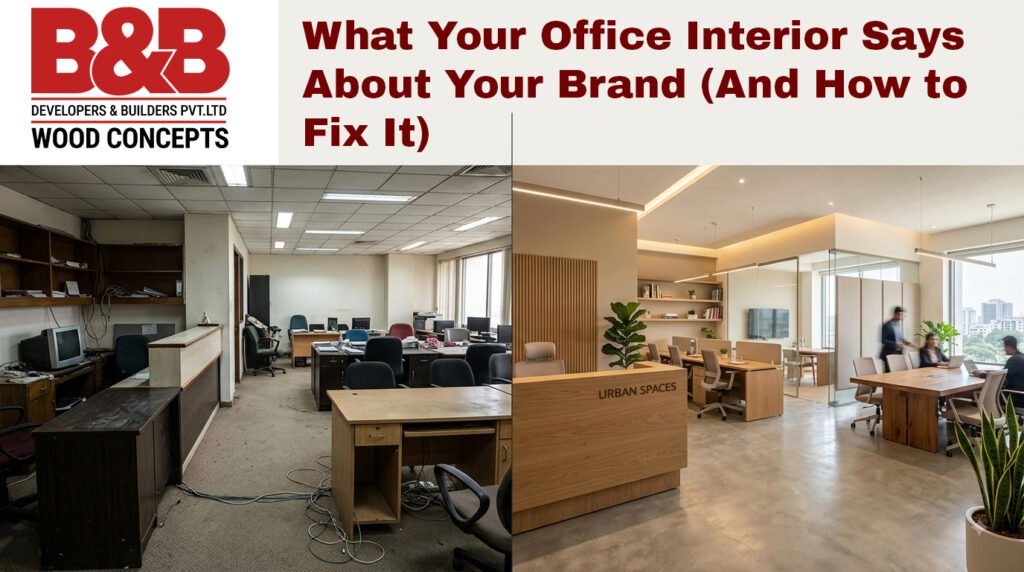
Your office interior communicates your brand’s professionalism, reliability, and attention to detail before a single word is spoken in a meeting. A cluttered, outdated, or poorly planned office signals disorganization to clients and lowers employee morale, while a clean, functional, well-designed workspace builds trust and reflects positively on your business. The fix starts with treating office interior design as a business investment, not a decoration expense — and working with an experienced corporate interior designer who understands both aesthetics and workflow.
If you’ve ever walked into a business and formed an opinion about it within seconds — before anyone greeted you — you’ve experienced exactly what your own clients experience in your office. This isn’t about luxury or extravagance. It’s about whether your space works, looks intentional, and represents your business accurately.
Most businesses invest heavily in branding — logos, websites, marketing — but treat their physical office as an afterthought. This is a mismatch. A visitor’s first real interaction with your brand often happens the moment they step through your office door, and that impression forms in seconds, long before your team gets a chance to speak.
Three things an office interior communicates, whether intended or not:
A cluttered reception area, mismatched furniture, or a chaotic workstation layout can undercut months of marketing effort in the time it takes a client to sit down.
It’s easy to underestimate how much an outdated or badly planned interior actually costs a business. The impact usually shows up indirectly, which is why it often goes unaddressed:
Clients and prospects unconsciously use environmental cues to judge reliability. A disorganized office can create doubt about how organized the business is behind the scenes — even if that’s not actually true.
Poor layout, inadequate storage, and uncomfortable workstations directly affect how efficiently a team can work. Employees spend time working around a bad space instead of the space working for them.
Workplace environment is increasingly a factor in hiring and retention decisions. A dated, uninspiring office can quietly work against recruitment efforts.
Offices that grew organically over time — furniture added piecemeal, no real layout plan — often waste significant square footage that could be used more effectively.
Fixing an office interior doesn’t require starting from zero. It requires identifying what’s actually not working and addressing it deliberately.
Walk through your office as if you were a first-time visitor. Note where clutter builds up, which areas feel cramped, and where furniture or fixtures look worn or mismatched.
Reception areas, meeting rooms, and any space clients or visitors see should be addressed early, since these carry the most weight in shaping first impressions.
A good office interior supports how people actually move and work — desk placement, storage access, and meeting room proximity all matter as much as visual style.
Custom-built furniture, particularly in wood, can be designed to fit exact space dimensions and usage needs, rather than forcing a space to accommodate generic, ready-made pieces. This is a core part of the wood design services approach — building furniture specifically for how a space will be used daily.
Office interiors have different requirements than residential spaces — higher daily use, professional appearance standards, and workflow considerations. Working with a firm experienced in corporate interior design and broader commercial interior design ensures these factors are planned for from the start, rather than fixed after the fact.
| Zone | Why It Matters |
|---|---|
| Reception Area | First point of contact for clients and visitors — sets the initial tone |
| Meeting Rooms | Reflects professionalism during client discussions and negotiations |
| Workstations | Directly affects daily employee efficiency and comfort |
| Cabins/Offices | Represents leadership and decision-making spaces |
| Common/Breakout Areas | Impacts employee morale and informal collaboration |
Addressing even two or three of these zones with intentional design can shift how a business is perceived, without requiring a full office overhaul.
1. How does office interior design affect client trust? Clients form impressions within seconds of entering a space, often unconsciously linking a clean, organized office to business reliability. A cluttered or outdated interior can create doubt, even when it doesn’t reflect the actual quality of the business’s work.
2. Do I need to redesign my entire office at once? No. Prioritizing high-impact, client-facing areas like the reception and meeting rooms first is often more practical and cost-effective than a full redesign, and still meaningfully changes first impressions.
3. Is custom furniture better than ready-made furniture for offices? Custom furniture, especially wood-based pieces, can be built to fit exact space dimensions and specific workflow needs, which ready-made furniture often can’t match. It’s a worthwhile option for offices with unusual layouts or specific storage requirements.
4. What’s the difference between corporate and commercial interior design? Corporate interior design focuses specifically on workplace environments — offices, cabins, and meeting rooms — while commercial interior design covers a broader range of business spaces, including retail and customer-facing establishments.
5. How long does an office interior redesign typically take? Timelines vary based on scope — a single zone like a reception area can be completed faster than a full-office redesign. A designer can give a realistic timeline once the scope and current space condition are assessed.
6. Can office interior design improve employee productivity? Yes. Layouts that support efficient movement, adequate storage, and comfortable workstations reduce daily friction for employees, which can have a measurable effect on how efficiently work gets done.
An office that looks intentional and functions well doesn’t happen by accident — it comes from treating interior design as part of how a business presents and operates, not as a cosmetic afterthought. Whether you’re addressing one problem zone or planning a full workplace redesign, the process works best when it starts with an honest look at how your current space is actually being used. Explore corporate interior design and commercial interior design services, or learn more about the interior design approach behind these projects.